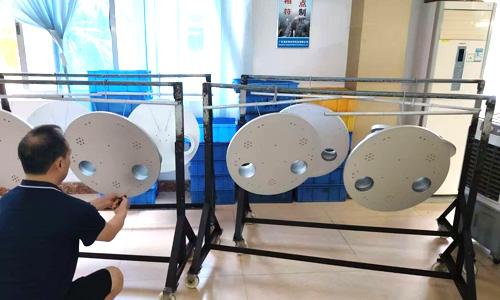
Plastics Network: The base material is not restricted, which can be metallic or non-metallic. Spraying can be performed on a variety of substrate materials. A wide range of coating materials are available for spraying. Thermal spraying technology can be used to spray almost all solid engineering materials, such as cemented carbide, ceramics, metals, graphite, etc. The temperature rise of the substrate during spraying is low without stress and deformation. The operation process is flexible and convenient, not limited by workpiece shape for easy construction. Coating thickness can range from 0.01 mm to several millimeters. Coatings feature diversified properties and can achieve special functions including wear resistance, corrosion resistance, heat insulation, oxidation resistance, electrical insulation, electrical conductivity and radiation protection. It boasts strong adaptability and favorable economic benefits.
Blushing: Low temperature tends to cause moisture condensation on the substrate surface. Blushing will occur when the relative humidity>85% or the moisture content of the board>12%.
Solutions:
1. Add 3–10% anti-blushing agent into the thinner, stir evenly before application; wipe off condensed moisture on the substrate surface with a dry towel before construction. For wet-on-wet application, extend the recoating interval appropriately. The recoating time shall be no less than 60 minutes and no more than 2 hours. Only one wet-on-wet operation is allowed. Subsequent coating can only be carried out after the paint film is fully dried and sanded. After wet sanding, allow at least 12 hours of air drying before recoating. Seal the boards with sanding sealer once after incoming inspection to effectively block moisture inside the board from penetrating into the paint film;
2. Pinholes and bubbles: Deep wood pores on timber surfaces and poor sealing, coupled with slow paint drying, easily lead to paint sinking from wood pores and forming pinholes. Air trapped inside deep wood pores will be squeezed out as paint penetrates, resulting in bubbles in the paint film. Solutions: Seal the boards with sanding sealer once after incoming inspection to effectively prevent paint sinking and pinholes. Sanding sealer delivers strong penetration to displace trapped air and eliminate bubbles in the paint film.
3. If wet sanding and polishing are required, the board surface must be fully dried (48 hours in summer, 96 hours in winter) before polishing. Otherwise, the paint film will turn hazy and fail to reach the expected finish. For latex paint on walls, do not apply when the temperature<5°C. Coating wood paint under low-temperature conditions brings slow drying and easily causes paint defects such as sagging, slow drying or non-drying, back tacking, lifting, wrinkling and blushing, pinholes and bubbles. Stop painting work in heavy wind, heavy fog weather, temperature<5°C or relative humidity>85%. Sagging — Paint flows due to slow drying at low temperature, resulting in uneven film thickness; severe sagging forms curtain-like runs while minor sagging appears like bead-shaped tears.
Solutions:
Use winter-grade thinner to speed up paint drying. Avoid heavy single coats; apply in two or multiple thin coats. Extend the recoating interval and wait for the previous coat to fully dry before applying the next coat. Reduce the amount of thinner moderately to increase paint viscosity. Slow drying / non-drying, back tacking, lifting and wrinkling: Low temperature prevents complete solvent volatilization and poor curing of the paint film. Solutions: Adopt winter-grade thinner to accelerate drying; appropriately increase the proportion of curing agent within 20% (excessive addition will make the paint film brittle) to promote fast curing. Ensure adequate ventilation for thorough solvent volatilization to avoid back tacking. Extend recoating time and apply the next coat only after full curing of the prior coat, so as to prevent lifting and wrinkling caused by the solvent of the top coat dissolving the uncured undercoat. Stop painting construction when relative humidity>85%; otherwise poor film formation will lead to chalking, loss of gloss and water marks.